🧠 Your Brain Wasn’t Built for This Much Bad News
Why constant crisis updates retrain your nervous system—and how to take your mind back

You open your phone. 📱
And before your coffee even cools, your body has already started to brace:
🔥 A war headline
📉 Economic fears
🗳️ Political infighting
📲 Viral tragedy
🧪 Health panic
Your jaw tightens.
Your heart races.
Your brain fogs.
You haven’t moved—
but your nervous system thinks you’re running for your life.
And honestly? That reaction makes perfect sense.
This is what happens when awareness becomes survival mode.
We’re not wired to process crisis after crisis before we even get out of bed.
It’s not because you’re too sensitive.
It’s because your brain is doing exactly what it’s supposed to do:
🔦 Detect threats
🚨 Fire alarms
💥 Get you ready for danger
But when those signals never stop coming, your body never gets the chance to stand down.
🧬 When Perception Becomes Instruction
Here’s what a lot of people don’t realize:
Your brain doesn’t just see information.
It absorbs it. It learns from it.
So every time you scroll through a worst-case scenario...
Every time you rewatch something awful...
Every time you relive a conversation that scared or upset you...
You’re not just reviewing facts.
You’re training your brain to expect danger.
And your body? It follows that lead.
🔬 Here’s What the Science Says
Amygdala fires — your brain’s alarm system goes off
Cortisol spikes — stress hormone floods your system
Muscles tense — your body physically braces
Prefrontal cortex dims — logic and focus go offline
Digestion slows, sleep suffers, and your thoughts race
And yes, this happens even when nothing is actually happening to you.
🧪 In one study, people who watched news coverage of a traumatic event showed more acute stress symptoms than those directly affected.
— Holman et al., Psychological Science🧪 In another, people who reduced news intake for just 7 days experienced:
⬇️ 25% lower cortisol
😴 Better sleep
🧘 More mental clarity
— Benedetti et al., Journal of Health Psychology
So no, you're not imagining it.
This constant stream of input is doing something real.
It isn't just "overstimulating" you—it's rewiring your nervous system.
🧭 Your Nervous System Is Telling the Truth
If you've felt edgy, tense, scattered, or foggy lately—your brain may not be broken.
It may be overloaded.
And that reaction doesn’t mean something’s wrong with you.
It means something’s working way too hard.
You care. 💛
You want to be informed. You want to show up. You want to get it right.
(That’s a good thing.)
But compassion without boundaries becomes burnout.
And eventually, your brain starts pulling levers to protect you.
It shuts things down.
Not because it wants to—but because it has to.
🧘♀️ Try This 30-Second Reset
If your mind feels noisy and your body feels tight—try this:
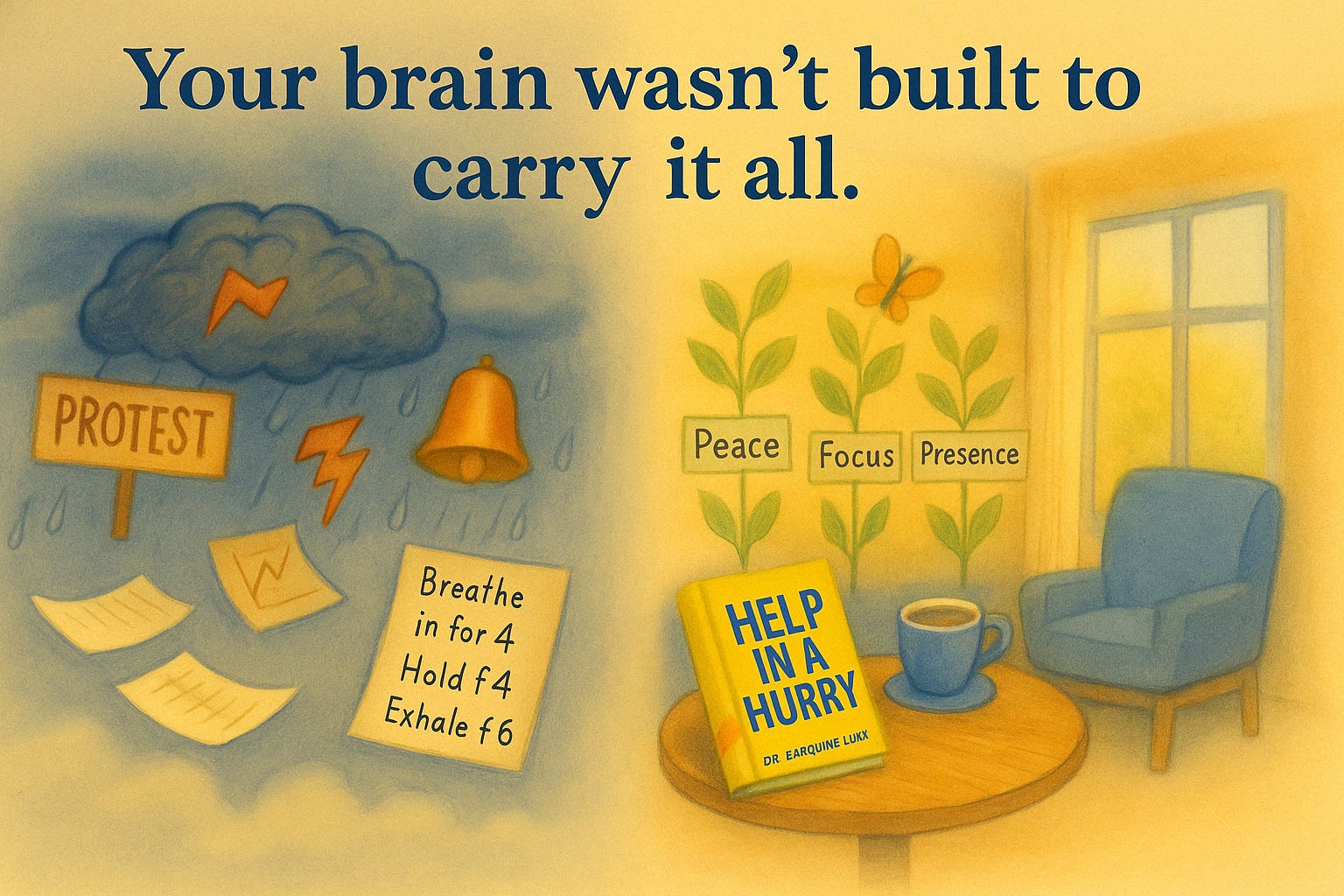
🌬️ Inhale for 4 seconds
⏸️ Hold for 4 seconds
🌫️ Exhale for 6 seconds
Repeat it 2–3 times.
This simple breath sequence activates your parasympathetic nervous system—the part responsible for calming you down.
It reduces cortisol.
It slows your heart rate.
It brings your brain back online.
It’s not a hack.
It’s a recalibration. 🧬
📘 If life feels loud lately, you're not alone.
And you’re not failing.
You’re responding—honestly, even wisely—to a world that doesn’t stop talking.
If your brain feels full and your body is bracing, I wrote a book to help.
It’s called Help in a Hurry—and it’s a toolkit for the moments when nothing seems to work and everything feels loud.
It’s short. Practical. Science-backed. And gentle.
💻 You can pre-order it here: www.HelpInAHurryBook.com
You deserve a nervous system that isn’t constantly trying to outrun the world.
Let’s make space for that.
Anyone else feel overloaded these days?
I love this - we need more conversations about this and how to handle modern life and the firehouse of data. It’s wild. Thank you for sharing - I look forward to your book!